
Suffering, Universalism, Exclusivity, Election – All At Starbucks
Sometimes I wish I could bring you in on some of the conversations we have at Doubt Night. So here’s a recount of some from our last one. These aren’t exact quotes or in exact sequence – but an abbreviated version of an hour and half conversation by my best memory a week later. Also names other than mine have been changed.Ajay: Here’s a quote by Epicurus, an ancient Greek thinker.“Is God willing to prevent evil, but not able?Then he is not omnipotent.Is he able, but not willing?Then he is malevolent.Is he both able and willing?Then whence cometh evil?Is he…
 Islam makes up around 20% of the world's population. It is the second largest religion in the world, trailing only Christianity. Muslims are spread primarily over the areas of North Africa, the Middle East, South-Central Asia, and Indonesia. Although Islam began in Saudi Arabia, non-Arab Muslims now outnumber Arab Muslims by a ratio of almost three to one. Also, the four nations with the largest number of Muslims today are all outside the Middle East. Indonesia-166 million (88% of the population); Pakistan-111 million (97%); Bangladesh-97 million (85%); and India-93 million (11%). Do you know that Islam is the fastest growing religion in the world today? Do you know that a significant number of immigrants who come to the United States are Muslims? And do you know that these immigrants come from many Islamic countries or countries with large communities of Muslims? Do you know that an estimated 4 to 6 million Muslims reside in the United States?
 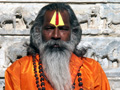 Hinduism is believed to be the oldest living religious traditions in the world. There are approximately one billion Hindus, making Hinduism the third largest religion in the world after Christianity and Islam, of whom approximately 890 million live in India (around 82% of India's population). It is estimated that adherents to Hinduism make up around 15% of the world's population. Other countries with large Hindu populations include: Bangladesh (11%), Bhutan (25%), Fiji (41%), Mauritius (50%), Nepal (89%), Sri Lanka (15%), Surinam (27%), and Trinidad (25%). Countries like Indonesia, Malaysia, South Africa, Tobago, and Guyana also have large number of Hindus. Nepal is the only nation where Hinduism is the state religion. There are more than two million Hindus in North America. Christian must consider Hindus as one of the largest people groups in their mission agenda. In the following paragraphs, we will learn about Hinduism in nutshell for the missional purposes.
 "And if a stranger dwells with you in your land, you shall not mistreat her/him. The stranger who dwells among you shall be to you as one born among you, and you shall love her/him as yourself; for you were strangers in the land of Egypt: I am the Lord your God" (Lev. 19:33-34, NKJV) There is much we can learn about our Asian neighbors, such as how they view themselves, what they believe about family, and why they have come to America. The more we know, the greater our understanding and enjoyment of Asian individuals-and the easier it is to share the good news of Jesus Christ with them. Below are a few facts about Asians in general.
 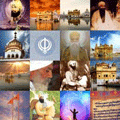 Sikhism founded on the teachings of Guru Nanak Dev and nine successive gurus in fifteenth century Northern India, is the fifth-largest religion in the world. The history of Sikhism began with the birth in 1469 AD of Guru Nanak Dev. The initiation (baptism) ceremony and other traditions of the religion were formalized by 1699 AD. This system of religious philosophy and expression has been traditionally known as the Gurmat (literally, the counsel of the gurus) or the Sikh Dharma. Sikhism originated from the word Sikh, which in turn comes from the Sanskrit root sisya meaning "disciple" or "learner", or siksa meaning "instruction". Sikhism advocates the pursuit of salvation through disciplined, personal meditation on the name and message of God. A key distinctive feature of Sikhism is a non-anthropomorphic concept of God, to the extent that one can interpret God as the Universe itself.
  Who we are before God is much more important than what we do for Him. From this message to Zerubabbel we can deduce the kind of people God is looking for. At least three qualities stand out: First God uses those who are humble. Not the pushy type or those who seek the spot light but are ‘lampstands’ filled with God’s gentle spirit. Second, God can use only those who are available: like these olive trees, people who are ‘there’ and ready to feed and serve others. Finally, God delights to anoint and use people who are reliable, who like Joshua and Zerubabbel stand continuously in the presence by the Lord. Humble, available and reliable. Are you someone God can use?
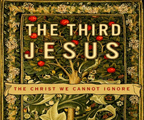 A recent book that’s appealing to a lot of post-moderns titled The Third Jesus: The Christ We Cannot Ignore by Indian-born doctor-turned-guru Deepak Chopra has got a lot of people seriously interested in thinking about Jesus–albeit in a different way. Definitely not in the way Jesus would want you to think about Him. This is a dangerous philosophy floating around with a lot of mumbo-jumbo sticking to it, much to the delight of unhappy Christians. Chopra, author of over 49 books on new-age subjects, portrays Jesus as a mystical person not the Savior of the world, certainly not an exclusive Savior. Jesus is not the only son of God, He is not the only way to heaven, He is not the exclusive God and the only God that orthodox or Biblical Christianity believes. To Chopra, Jesus would never offend homosexuals, or sinners. He simply accepts them. He is here to make us all experience God-Consciousness–a term confusing and bewildering that many despaired Christians find riveting due to its esoteric appeal. Sadly, many Christians who don’t understand the deceptions of Eastern philosophies like Yoga and New Age would easily shift their worldview to this new-age claptrap.
  The older and more mature in the Lord I become, the more I have learned to simplify my life and personal goals. Years ago my personal mission statement, vision statement, and goals were about two pages long. Now they are all one short sentence: “Love God and love people.” In my opinion, many of the popular self-help teachings in books today are for people that don’t know themselves or God very well. The more you mature in the Lord the less you rely on these “training wheels.” Many self-help teachers and motivational speakers get into things that are very practical, but without the leading of the Lord it is often akin to humanism.
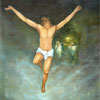 Most of the early years of my life, I lived a life of illusion trying to cover the vacuum in me through food, friends, entertainment, education and work. My conscience knew for the most part what was right and what was wrong. Yet I leaned towards doing what is wrong. I was never able to prevail against the power of sin. I tried to beat the shortcomings in my life, but to my dismay all the contending was in vain. I knew my life was being led in a way opposite to where my own conscience accused me. But I was stubborn and made all excuses and justifications to lead my life the way I wanted. Gradually my conscience started to get hardened and I found myself spiritually estranged and in bondage to all kinds of evil deeds. I used to wonder if there was ever a way out of the burden some, monotonous cycle of life's misery.
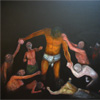 In our humanity, we find a ‘false richness’ in the many things that surround us. We find our fulfillment in the words of encouragement from our friends; we lust for pleasure and comfort; we run after things that we think really matter; we find ourselves in the secular game of being fashionable and relevant and ‘well-put-together’. In his words Jesus asks us to embrace our poverty. We are the frail and worn, the weak and needy, the sick and wanting, the hidden and poor. Through our unique walks of life, we encounter our own poverty. We are the poor, not the rich. When Jesus speaks of poverty, He does so to imply that on our own we are capable of little. We are vulnerable to weaknesses in our flesh, weakened by the gross sinfulness of the world, and powerless to fight the attacks of the enemy. On our own we do not amount to much. At the end of the day, we are possessors of nothing.